
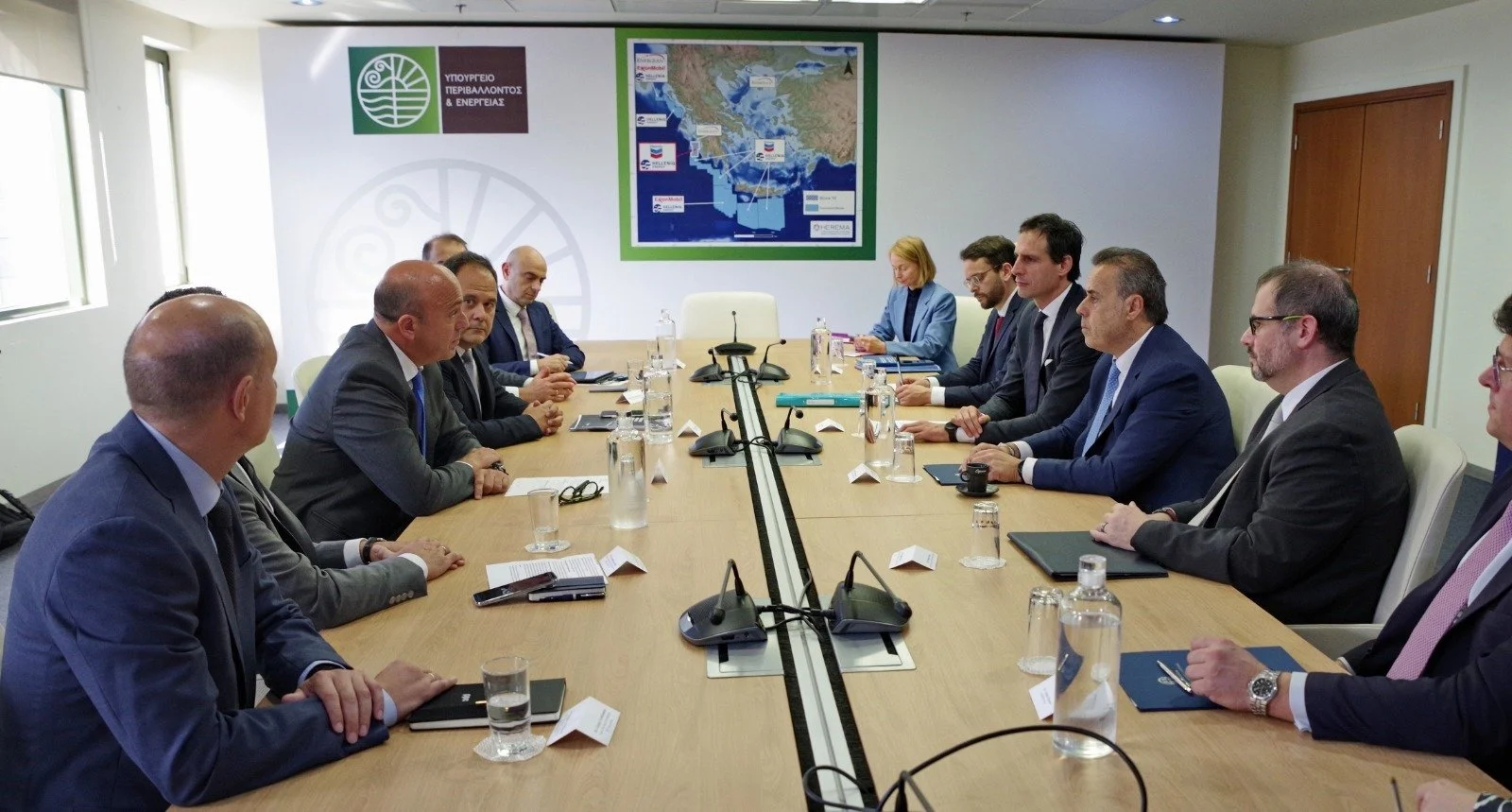
Greece’s ambitions in renewable hydrogen, floating offshore wind, energy storage and industrial decarbonisation were in focus during European Climate Commissioner Wopke Hoekstra’s visit to Athens, where he met Environment and Energy Minister Stavros Papastavrou and representatives of four Greek projects selected for EU Innovation Fund support.
The meeting brought together HERACLES Group, PPC Renewables, TERNA Energy and Hellenic Hydrogen, highlighting investments across Greece’s energy and industrial sectors.
HERACLES Group, part of Holcim, is developing ORION, which aims to reduce emissions from cement production through fully electrified production of calcined clay. PPC Renewables’ TALOS project will develop a large-scale renewable energy microgrid with long-duration storage in Crete.
TERNA Energy’s AEGEANFLOAT involves a pilot 45 MW floating offshore wind farm in the Aegean, while Hellenic Hydrogen’s AN-1-B project targets renewable hydrogen production through 50 MW of electrolysis capacity.
The four initiatives are among 77 projects across 23 European Economic Area countries selected by the European Commission on October 19, 2026, for a combined €3.4 billion in proposed grants. The Commission estimates that the projects could avoid approximately 290 million tonnes of CO₂-equivalent emissions during their first decade of operation.
Selected developers will now prepare grant agreements with the European Climate, Infrastructure and Environment Executive Agency, with the outcomes expected in the first quarter of 2027. The funding therefore represents selection for support, with final contractual arrangements still to be completed.
During the Athens discussions, Papastavrou stressed that the transition towards net zero must support social cohesion and economic competitiveness. Hoekstra highlighted the role of innovative businesses in translating European climate policy into industrial investment.
The visit also included Athens International Airport, where the officials reviewed its ROUTE 2025 programme and renewable energy infrastructure. The €70 million investment combines solar generation and energy storage, illustrating the role of clean electricity in strengthening energy autonomy across major transport infrastructure.
Financed through revenues from the EU Emissions Trading System, the Innovation Fund is expected to mobilise around €40 billion over 2020–2030 to help bring innovative low-carbon and net-zero technologies to market.
