
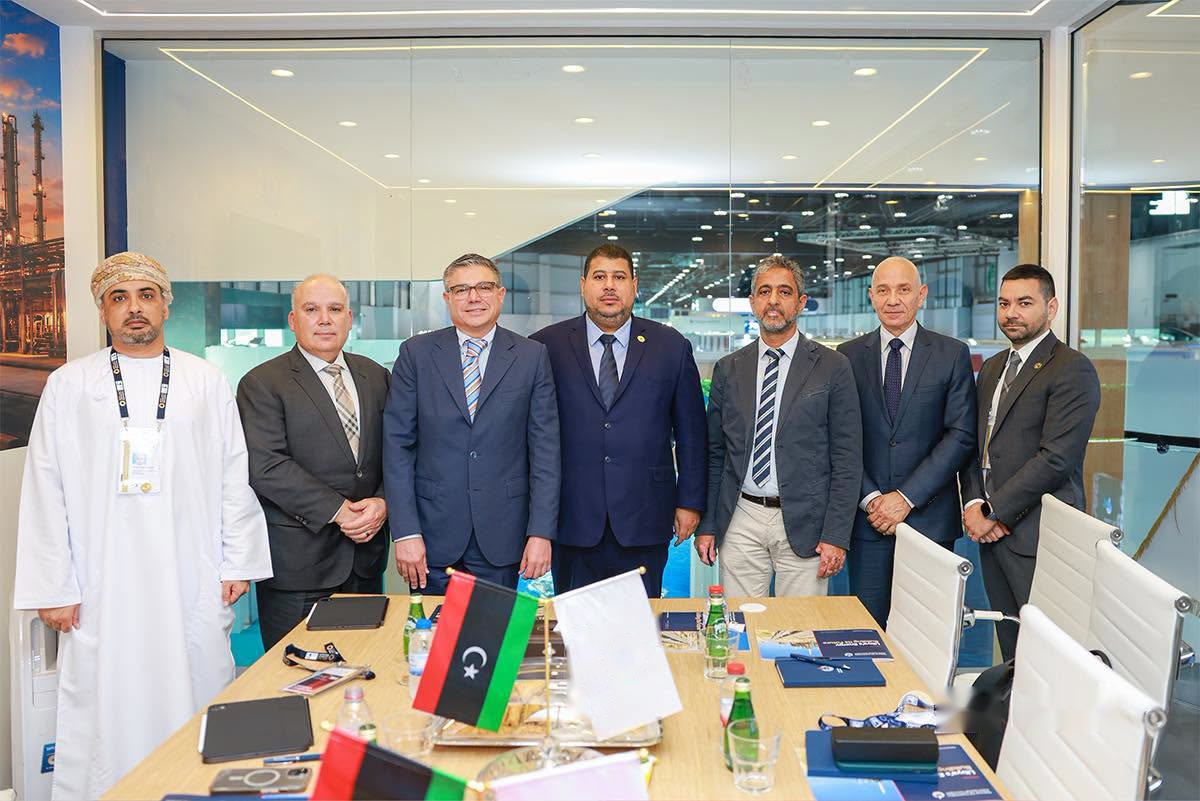
Baker Hughes plans to open an office in Libya as it expands cooperation with the country’s National Oil Corporation (NOC). The plan builds on the company’s work with Libyan operators to drill new wells and restore production from long-idle ones.
NOC Chairman H.E. Masoud Suleman welcomed the plan following talks with Baker Hughes at ADIPEC 2026 in Abu Dhabi. He said the office would strengthen the company’s presence in Libya and support closer cooperation with the NOC. The announcement did not specify a location or an opening date.
Restoring Production at the Majid Oilfield
On November 5, the NOC said its subsidiary Arabian Gulf Oil Company (AGOCO) had brought the Z3HR-80 well into production after more than 22 years as a non-producing observation well. Working with Baker Hughes and Camco, AGOCO re-entered the existing well and used directional drilling to bring it into production. The well flowed naturally at 7,355 barrels of oil per day during testing, with no water produced alongside the oil.
In September, the same companies helped restore production from the EE1HR-80 well at Majid after nine years offline. It recorded a test rate of 5,322 barrels per day. Both projects are part of the NOC’s effort to raise output from existing fields by rehabilitating idle wells.
Baker Hughes Technology in Other Libyan Fields
Baker Hughes has also worked with local partners on new wells. In 2025, Camco used Baker Hughes tools to drill a horizontal well for Waha Oil Company in the Defa reservoir. The tools let engineers steer the drill and map the reservoir as they drilled, helping keep the well within the targeted layer of rock. Camco reported initial production of 4,100 barrels per day.
At the Methkandoush field in the Murzuq Basin, Baker Hughes helped Camco model the reservoir for a Sirte Oil Company well. The model helped engineers identify naturally fractured rock and plan a 700-foot horizontal section through areas where oil could flow more readily. The NOC reported a natural flow rate of 6,000 barrels per day during initial testing.
Field Support and Training
Baker Hughes and AGOCO have discussed extending their cooperation into well maintenance, production software and troubleshooting equipment at the surface. In August, they reviewed plans to bring additional equipment and specialist teams into Libya. A November listing on Baker Hughes’ careers site also sought candidates for future field engineering work in Libya covering cementing, coiled tubing and production enhancement.
Training has been part of the NOC’s talks with Baker Hughes. At a meeting with Simonelli in Florence in January, Suleman encouraged the company to participate in projects to expand Libya’s production capacity. The two sides discussed introducing newer drilling and production technologies and training Libyan personnel to use them. In March, Suleman met with the company’s CEO again at CERAWeek in Houston, where he urged international energy companies to reestablish offices in Tripoli.
