
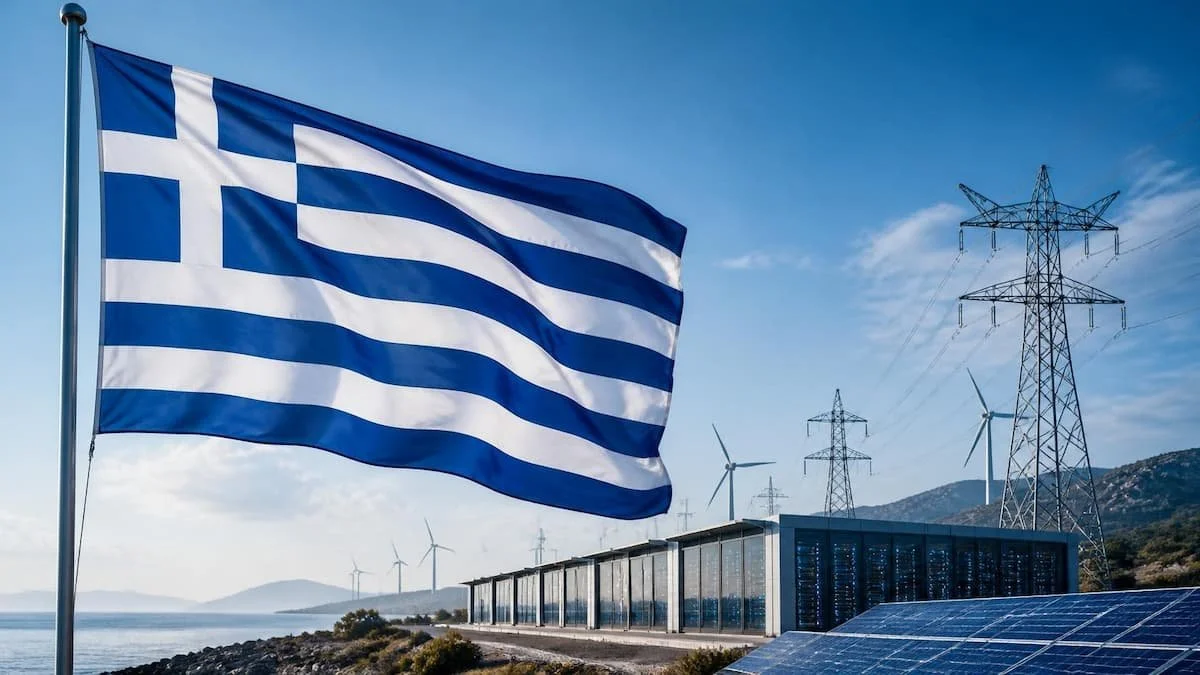
Greece has recorded a new high in electricity exports during the first eight months of 2026, reinforcing its position as a major electricity supplier in Southeastern Europe. The country’s growing renewable energy capacity and investments in cross-border infrastructure have contributed to a significant improvement in its electricity trade balance.
According to data from the Independent Power Transmission Operator (IPTO) and the Hellenic Statistical Authority (ELSTAT), Greece’s net electricity exports reached 6.1 terawatt-hours (TWh) between January and August 2026, surpassing the total recorded throughout 2025.
During the eight-month period, electricity exports increased by 70% year-on-year to 9.24 TWh, while imports declined by 27% to 3.14 TWh. The figures highlight Greece’s transition from a historically electricity-importing country into an increasingly important regional exporter.
Renewable Energy and Infrastructure Drive Growth
The expansion of Greece’s electricity exports has been supported by increasing domestic renewable energy generation, particularly solar and wind power, alongside continued investments in electricity transmission infrastructure.
Manos Manousakis, Chairman and CEO of IPTO, attributed the country's improving electricity trade performance to its national energy strategy, which prioritizes renewable energy development and the modernization of electricity networks.
According to Manousakis, Greece has experienced consistent growth in net electricity exports over the past three years, with the first eight months of 2026 already exceeding the previous year's total.
The trend reflects the growing importance of renewable energy in strengthening Greece’s energy security, supporting electricity production, and expanding opportunities for cross-border energy trade.
Greece Plans Major Expansion of Electricity Interconnections
Looking ahead, Greece is pursuing several major electricity infrastructure projects aimed at strengthening its connections with neighboring countries and expanding its role in regional energy markets.
Following the completion of a second electricity interconnection with Bulgaria, IPTO is advancing the Greece–Cyprus electricity corridor and working with Italian transmission operator TERNA on a second submarine electricity interconnection between Greece and Italy.
These developments are expected to triple electricity exchange capacity in the coming years, supporting increased cross-border electricity flows and greater integration with European energy markets.
Additional investment plans include upgrading existing electricity connections along Greece’s northern borders, developing new interconnections in the Eastern Mediterranean, and strengthening the country’s domestic high-voltage transmission network.
The projects are intended to improve grid reliability, accommodate additional renewable energy generation, and facilitate electricity exports to regional markets.
Electricity Trade Surplus Reaches €475 Million
Greece’s expanding electricity exports have also delivered substantial economic benefits.
According to ELSTAT, the country recorded an electricity trade surplus of €475 million during the first eight months of 2026, exceeding the €261.8 million surplus registered throughout 2025.
Electricity exports were valued at €866.8 million during the period, compared with imports worth €391 million.
The figures represent a significant reversal from 2019, when Greece imported nearly 10 TWh of electricity, equivalent to approximately 20% of domestic demand.
At that time, the country recorded an electricity trade deficit of nearly €400 million, with electricity imports exceeding €500 million and exports totaling just €106.7 million.
The electricity trade balance subsequently moved into surplus in 2024, reaching €121.5 million, before expanding further in 2025 and 2026.
The shift from a deficit of almost €400 million in 2019 to a surplus of €475 million in the first eight months of 2026 represents an improvement of approximately €875 million.
Strengthening Greece’s Role in Southeastern Europe
Greece’s record electricity export performance highlights the country's growing importance in Southeastern Europe’s evolving energy landscape.
With continued investments in renewable energy, cross-border interconnections, and electricity transmission infrastructure, Greece is positioning itself as an increasingly important regional electricity supplier.
The expansion of export capacity is also expected to support regional energy integration, improve electricity market connectivity, and create additional opportunities for investment in Greece’s energy sector.
