
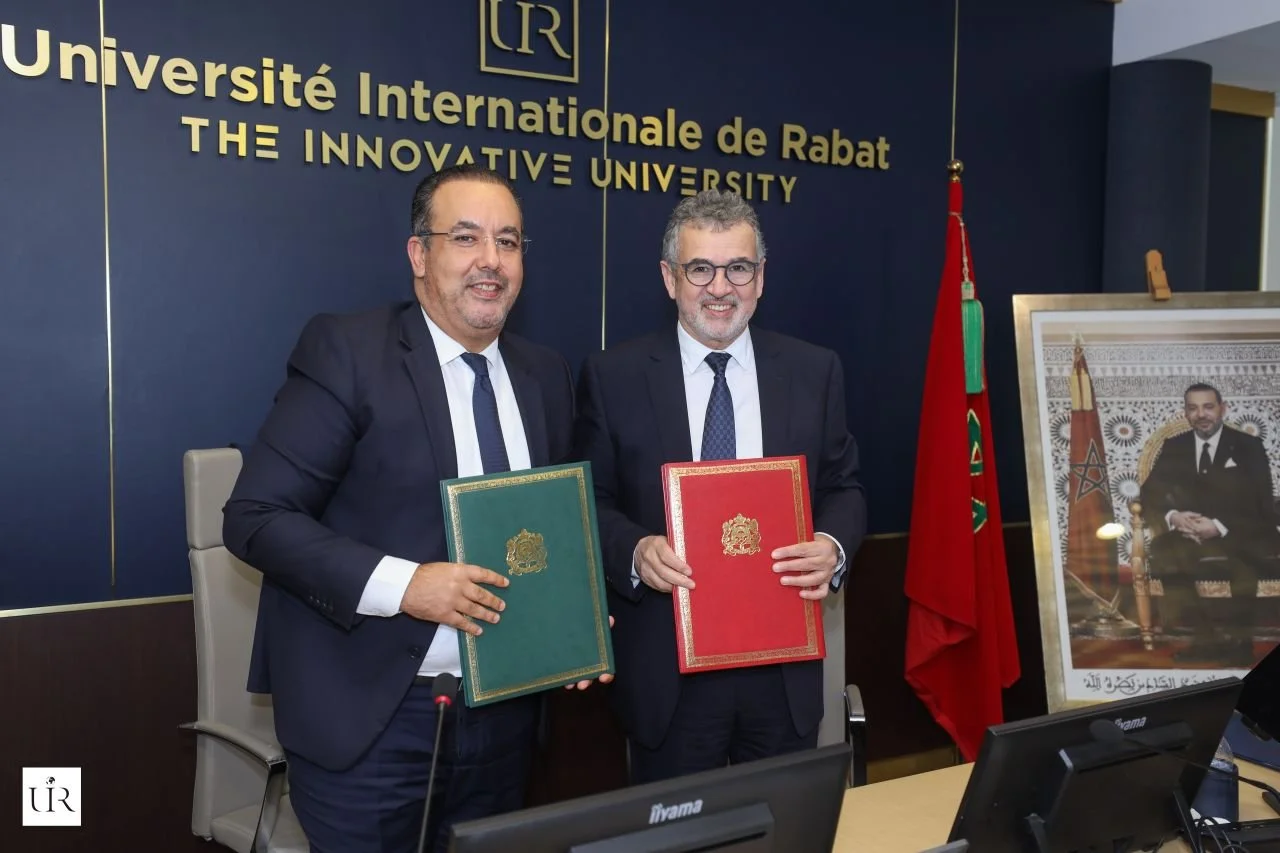
The Moroccan Agency for Sustainable Energy (MASEN) and the Université Internationale de Rabat (UIR) signed a memorandum of understanding in Rabat on November 2, 2026, setting a framework for long-term cooperation in applied research, technological innovation, and skills development.
The agreement links UIR’s scientific expertise with MASEN’s operational experience as well as its research infrastructure and demonstrators. The goal, according to the two institutions, is to advance technologies proven in real operating conditions and adapted to Moroccan conditions.
Focus areas
The cooperation will focus on five areas:
Renewable energy technologies
Battery storage
Mini grids
Green hydrogen
The use of artificial intelligence and digital tools in energy forecasting
The MoU sets a framework for cooperation. Neither institution has yet disclosed specific projects, funding commitments, research programs, or a timeline.
Building on MASEN’s testing infrastructure
The agreement’s reference to demonstrators points to one of MASEN’s distinctive assets. The agency operates a dedicated research and development platform at the Noor Ouarzazate solar complex. According to an agency presentation, the platform qualifies innovative renewable energy technologies and hosts at-scale demonstration pilots that test component and system reliability under real operating conditions. The test sites sit on the production sites themselves, and MASEN has described its R&D approach as aimed at moving technologies from laboratory demonstrators toward demonstration in operational environments.
The platform already has storage experience. A partnership with UNIDO that began at COP22 in Marrakech led to a vanadium flow battery pilot on MASEN’s R&D platform in Ouarzazate.
For a university, access to field conditions can be the difference between promising lab results and technology an operator can deploy. Factors such as heat, dust, and seasonal variation affect the performance of solar equipment, storage systems, and forecasting models. These conditions are difficult to replicate on campus.
Why the focus areas matter
The chosen topics reflect pressures facing Morocco’s power system as renewable capacity grows. Founded in 2010, MASEN oversees the country’s renewable energy program, which targets a 52% renewable share of the national electricity mix by 2030. Earlier agency material specified this target as 52% of installed capacity.
A larger share of variable solar and wind generation increases the need for storage and accurate output forecasting. AI-based forecasting can help grid operators manage variable supply. Battery storage can shift solar output into evening demand peaks.
Mini-grids serve a different purpose. They supply power to remote communities and industrial sites far from the main grid. Green hydrogen, meanwhile, is central to Morocco’s ambition of using its solar and wind resources for export-oriented clean fuels and for decarbonizing industries such as fertilizers.
Skills as a commercial issue
The skills component may prove as significant as the research itself. As Morocco expands its renewable, storage, and hydrogen pipeline, demand is growing for engineers, data specialists, and technicians who can design, operate, and maintain these systems.
Partnerships that tie university training to operational needs can help companies and investors find qualified staff locally. This in turn supports the industrial integration goals Morocco has pursued alongside its renewable energy buildout.
The two institutions said the agreement reflects their aim to strengthen links between academic research and industry needs, support the development of innovative industrial solutions, and train highly qualified talent.
What comes next
The memorandum’s practical impact will depend on how it is implemented. Key questions include which joint projects are launched, how researchers and students gain access to MASEN’s demonstration sites, and whether results move toward commercial deployment. Neither party has announced specific programs, budgets, or milestones.
