
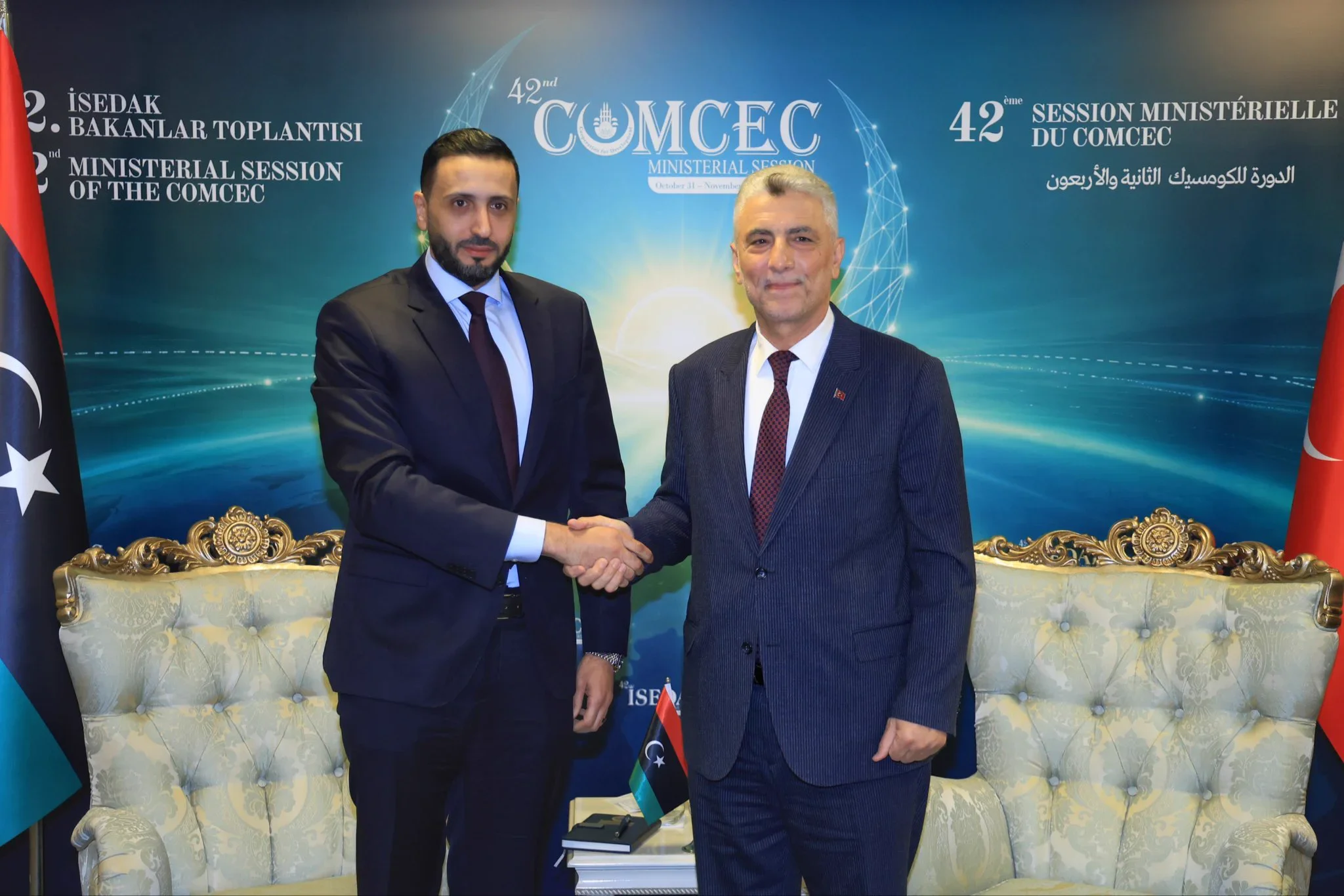
Turkey and Libya have recommitted to raising bilateral trade to $5 billion, as the two governments prepare for the first meeting of a new joint trade commission and a business and investment forum aimed at drawing in private-sector players from both sides.
The pledge followed talks in Istanbul between Turkish Trade Minister Ömer Bolat and Suhail Aboushiha, Minister of Economy and Trade in Libya’s Tripoli-based Government of National Unity (GNU). The meeting took place on the sidelines of the 42nd Ministerial Session of the Organization of Islamic Cooperation’s Standing Committee for Economic and Commercial Cooperation (COMCEC) in Istanbul.
In a social media statement after the meeting, Bolat said the shared goal of lifting trade to $5 billion had been confirmed once again, and pointed to historical ties between the two countries that he said stretch back more than 500 years.
Forum and JETCO in preparation
The ministers discussed organizing a Turkey–Libya Business and Investment Forum alongside the first meeting of the Joint Economic and Trade Commission (JETCO). No date for either event has been announced.
The Libyan ministry set out how it expects the target to be reached: by reviving trade exchanges, broadening private-sector participation and creating new opportunities for investment partnerships between companies from both countries.
The JETCO framework itself is relatively new. In October 2025, the two governments signed a joint declaration establishing the commission, alongside two memoranda of understanding on contracting receivables and new-era projects, during the Türkiye-Africa Business and Economic Forum in Istanbul.
Contractors remain central
The talks also reviewed progress in resolving problems facing Turkish companies that undertook their first overseas projects in Libya. Bolat said Ankara aims to further develop the legal framework underpinning economic cooperation and to strengthen trade and investment ties.
Construction is the most commercially significant thread in the relationship. Turkish contractors have completed 641 projects in Libya worth $31.5 billion, according to figures Bolat cited in September 2025. Many of those firms were left with unfinished projects and unpaid claims after the 2011 conflict. At a joint working group meeting in Ankara in September 2025, the two sides discussed settling construction contracts concluded before 2011, followed up on contracts signed in 2024 and 2025, and worked on a practical program for resuming stalled development projects.
For Turkish contractors, resolving legacy receivables and guarantees is a precondition for scaling up new work. For Libya, it bears directly on the pace of reconstruction and infrastructure delivery.
How close is the target?
The $5 billion goal is not new. In 2025, Bolat said the two countries had jointly set a target of lifting annual trade from $3.7 billion to more than $4 billion that year and to $5 billion the following year
Trade has moved in that direction. Bilateral trade rose 31% in the first eight months of 2025 compared with the same period in 2024, and Turkish Energy Minister Alparslan Bayraktar later reported that Turkey-Libya trade reached approximately $4.4 billion in 2025. Full-year 2026 figures are not yet available, and the reaffirmation suggests the target remains a work in progress.
Libya has signaled a longer term ambition as well. In May 2025, then-Economy Minister Mohamed Al-Hwaij said Libya aimed to raise annual trade with Turkey to $10 billion.
Why it matters
The trade relationship rests on more than goods. Turkey is a major supplier to the Libyan market, while Turkish construction, energy and transport firms see Libya’s reconstruction needs as a sizeable pipeline. Bayraktar has described 2026 as an “energy year” for Turkey-Libya cooperation, signaling Ankara’s interest in moving beyond contracting and consumer goods.
Practical links have also expanded, including a new visa system offering Libyans long-term and multiple-entry visas, introduced in September 2025, and about 50 weekly flights between the two countries.
The challenges are institutional as much as commercial. Libya’s divided governance, payment delays and the legacy of stalled contracts continue to shape risk for foreign companies. Whether the forthcoming JETCO session and investment forum translate into firm contracts, settled receivables and new private-sector partnerships will be the clearest test of the $5 billion pledge.
